Making Real-Time Corrected Parametric Measurements Using a Digital Oscilloscope
Making ‘Real-Time Corrected' Parametric Measurements using a Digital Oscilloscope
While accurate rise time measurements have become easier to make, it remains, nonetheless, quite easy to overlook error contributions due to not only the oscilloscope but also the probe. And, while the error contributed by a scope's finite step-response (rise time) is often accounted for, that contributed by the probe is often overlooked. The probe contributes its own source of error due to its own characteristic rise time. In this article, we will examine rise time measurements made while using a Gaussian scope and a probe, each of a known BW. Furthermore, we will look at how to make a systematic on-the-fly corrected rise time measurement using the DL9000 oscilloscope.
For a test system with a low-pass Gaussian frequency response, every element between the test point and the display of an oscilloscope contributes to the measured rise time (1). In the case of a DUT's rise time, a probe's rise time, and an oscilloscope's rise time, these three rise times may be summed by:


Related Products & Solutions

DL9000 DSO Series
500MHz, 1.0GHz, and 1.5GHz DSOs for debug and high performance applications. 10th
generation oscilloscope from Yokogawa with industry leading 2.5 million wfms/sec and lowest dead time. Winner of Test & Measurement World's "Best in Test" award.

DL9000 MSO Series
500MHz, 1.0GHz, and 1.5GHz MSOs for debug and high performance applications. 4 channel models with 16 or 32 logic inputs. 10th generation oscilloscope from Yokogawa with industry leading 2.5 million wfms/sec and lowest dead time.

DLM2000 Mixed Signal Oscilloscopes
200, 350, and 500MHz mixed-signal oscilloscopes for every engineer. Best-in-class performance in usability, acquisition, analysis, and display—all at a price you can digest. Options include serial bus, vehicle bus, and power supply analysis functions.

DLM4000 Series Mixed Signal Oscilloscope
8 channel mixed-signal oscilloscopes for every engineer in bandwidths of 350 MHz or 500 MHz. Best-in-class performance in usability, acquisition, analysis, and display.
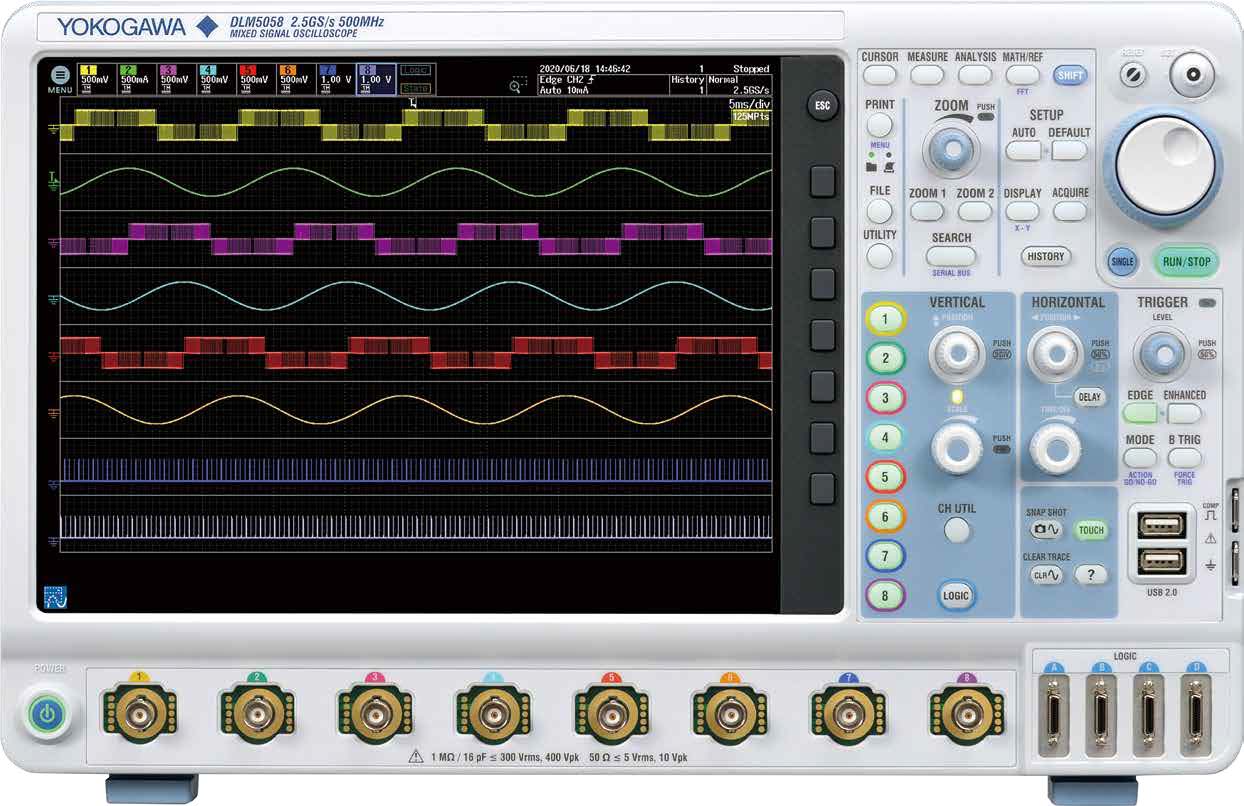
DLM5000 Series Mixed Signal Oscilloscope
- 4-to-8 channel Yokogawa DLM5000- best mixed signal oscilloscope
- Responsive touchscreen for easy navigation through analysis features

DLM5000HD Series High-Definition Oscilloscope
The DLM5000HD High-Definition Oscilloscope from Yokogawa Test&Measurement is the new standard of high-definition oscilloscope.
- Frequency Bandwidth: < 500 MHz
- Sample Rate: < 2.5 GS/s
- Vertical Axis Resolution: 12 bit
- High Resolution Mode: < 16 bit
- Measurement Memory: < 1 G points
- History Waveforms: < 200,000
- Simultaneous Multi-Channel Measurements: < 32 bit logic + 8 channels
- < 16 channels with two connected DLM5000HDs via DLMsync
- Highly-Responsive, Intuitive 12.1in Touchscreen
- with Traditional Oscilloscope Control Panel
- IEEE1588 Synchronous Support
- Superior Noise Immunity
- Vehicle Serial Bus
- Additional Math Channels
- Extensive Voltage Ranges
- Compact, Light, Portable

DLM6000 MSO & DSO Series
500MHz, 1.0GHz, and 1.5GHz DSO and MSO models for debug, waveform characterization, bench top, or automated test applications. 4 channel models with 16 or 32 logic inputs. 12th generation oscilloscope with ergonomic physical and on-screen improvements.

