AQ23291A Optical Sensor Head (InGaAs)


Large-Area InGaAs Sensor Head for Long-Wavelength Optical Power Measurement
The AQ23291A is an optical sensor head for measuring optical power over a wavelength range of 800 to 1700 nm. Its large-area InGaAs detector supports measurements of light from single-mode fibers, multimode fibers, and free-space optical sources.
The sensor head can be positioned close to the device or optical source under test, providing flexibility for optical component evaluation, multi-fiber connector testing, and measurement setups where direct access to the optical signal is required. The AQ23291A is used with the AQ23202A Interface Module in an AQ2300 Series Test Platform.
Key Specifications
- Detector type: InGaAs, φ5 mm
- Power range: −90 to +15 dBm (CW)
- Wavelength range: 800 to 1700 nm
- Uncertainty under reference conditions: ±1.8%
- Averaging time (minimum): 20 µs
- Applicable fiber: SMF, MMF
- Connector: FC, SC, LC, MU (MPO is also available as an optional accessory.)
- Cable length: 1 m, 4 m
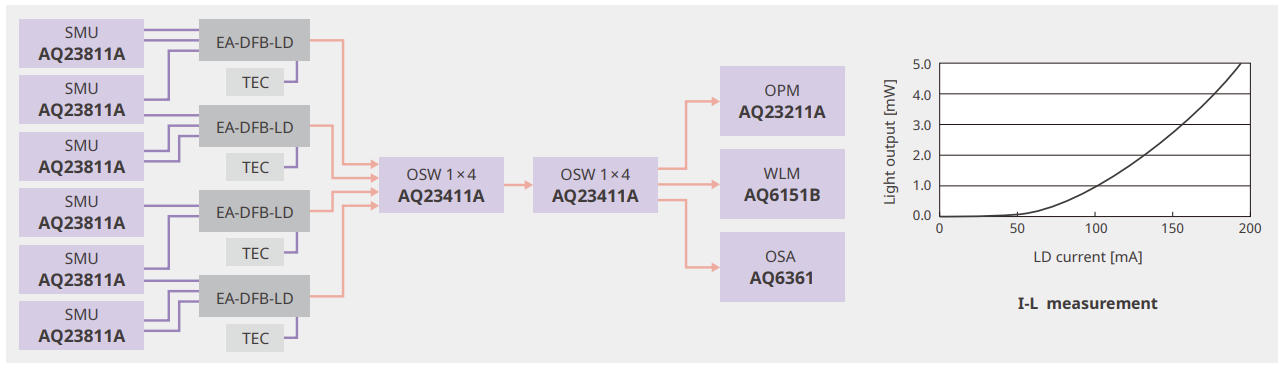
Static characterization of laser diode (LD) and photodiode modules
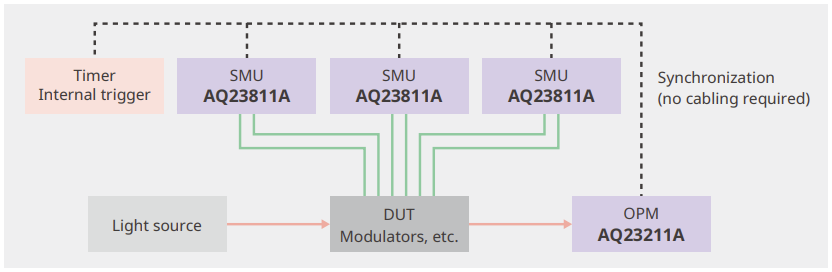
The AQ2300 streamlines the test by synchronizing source measure unit (SMU) and optical power meter (OPM) measurements during sweep measurements in a single test platform. enabling electrical and optical parameters to be synchronously acquired in a single platform. This built-in inter-channel synchronization enables efficient I-L characterization without additional external synchronization wiring. For more comprehensive optical characterization, the measurement system can be integrated with the AQ6151B Optical Wavelength Meter and AQ6361/AQ6370E Optical Spectrum Analyzer to evaluate wavelength and spectrum alongside electrical and optical power characteristics.
[Measurement items] I-L measurement, DC extinction ratio, PD current, modulator current, wavelength, spectrum
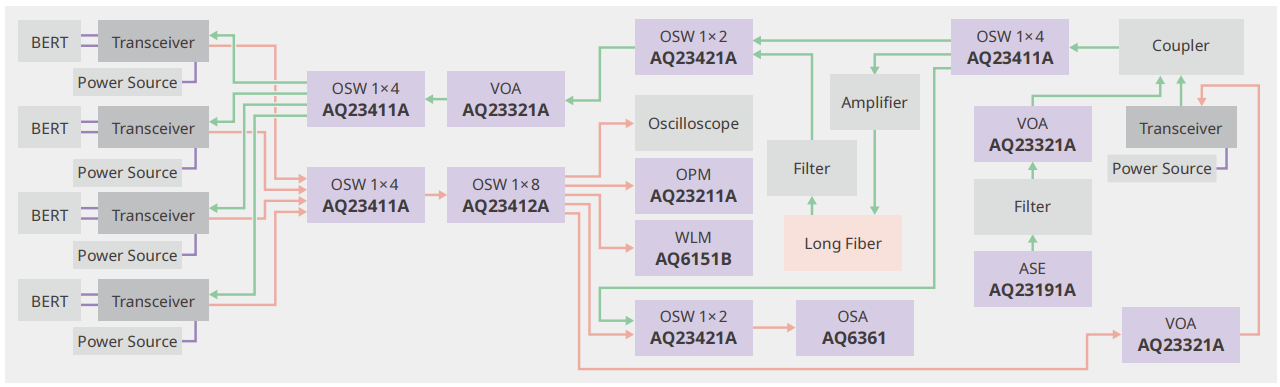
Optical transceiver measurements
The AQ2300 provides comprehensive optical transceiver evaluation by combining optical power measurement, optical attenuation, optical path switching, and ASE noise loading within a modular system. Multiple transceiver channels can be routed through optical switches, while variable optical attenuators enable controlled adjustment of optical signal levels. When combined with the AQ6151B Optical Wavelength Meter and the AQ6361/AQ6370E Optical Spectrum Analyzer, the system also delivers comprehensive wavelength and spectral analysis. The AQ23191A ASE Light Source can also be incorporated into the optical path to evaluate transceiver performance under controlled ASE noise-loading conditions.
[Measurement items] Optical power, wavelength, Spectrum, optical power adjustment, ASE noise loading
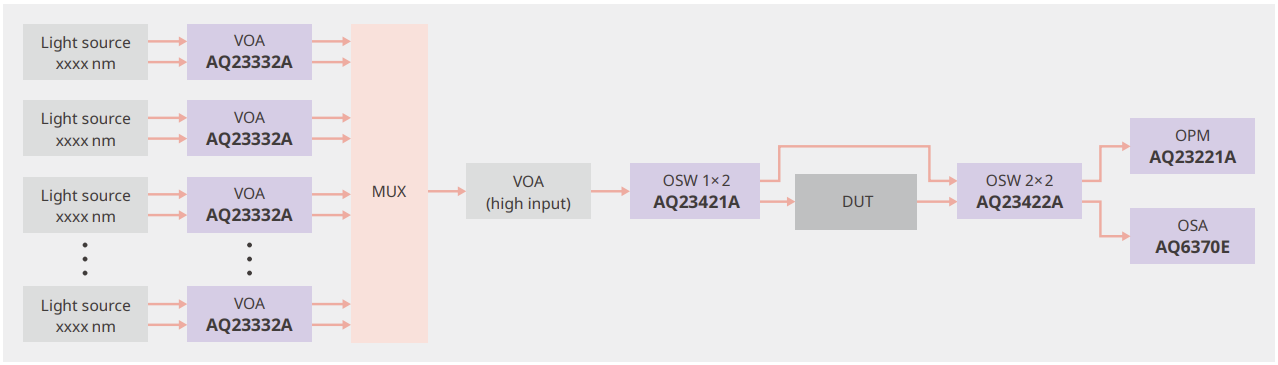
Optical Fiber Amplifier Measurements
The AQ2300 supports optical fiber amplifier evaluation under wavelength-division multiplexed (WDM) conditions. Multiple optical signals at different wavelengths can be independently controlled, attenuated, and multiplexed to create realistic inputs for the amplifier under test. Combined with the AQ6370E/AQ6361 Optical Spectrum Analyzer, the system can evaluate gain, gain flatness, noise figure, and ASE across multiple wavelength channels. The AQ6370E/AQ6361 provides dedicated optical amplifier analysis capabilities for gain and noise figure evaluation, while the AQ2300 enables flexible control of optical power levels and measurement paths for multi-wavelength testing.
[Measurement items] Gain, gain flatness, noise figure, ASE noise
Loss measurement of optical passive components
The AQ2300 supports measurement of optical loss measurements for passive components such as optical fibers, connectors, couplers, etc. By combining optical sources, power meters, attenuators and switching modules in single modular system, engineers can evaluate the optical insertion loss and crosstalk of various optical passive components.
[Measurement items] Optical insertion loss, crosstalk

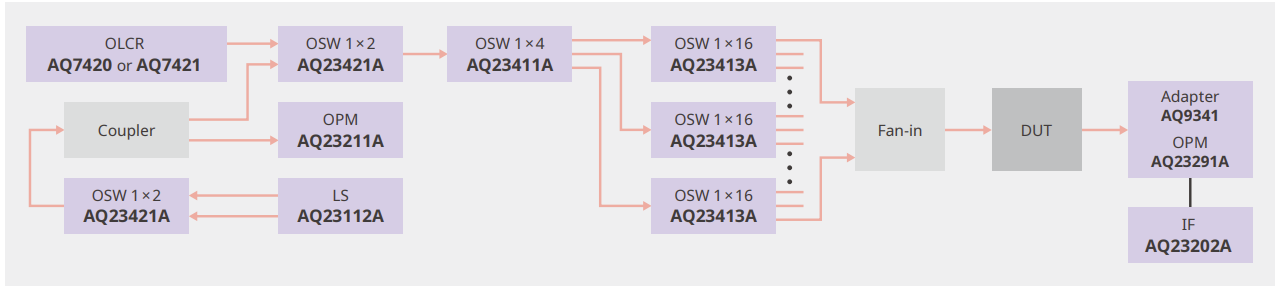
MPO component inspection system
The AQ2300 can be combined with the AQ7420 or AQ7421 High-Resolution Reflectometer to build a multi-fiber inspection system for MPO and multi-fiber optical components. Optical switches route the measurement path across multiple fibers, enabling insertion loss and optical return loss measurements in a multi-channel configuration. The AQ7420 and AQ7421 provide high-resolution reflection analysis to identify the position and magnitude of localized reflections, helping detect defects such as micro-cracks that may be difficult to identify through conventional loss measurements alone. By combining this detailed reflection analysis with the AQ2300's flexible optical switching and power measurement capabilities, the system supports comprehensive evaluation of insertion loss, total and partial optical return loss, and micro-cracks in MPO components.
[Measurement items] Insertion loss, total optical return loss, partial optical return loss, micro-crack detection
High-speed sweep testing of multi-power-supply optical devices
The AQ2300 enables high-speed synchronized sweep measurements for devices with multiple electrical signals. By taking advantage of the AQ2300’s internal trigger and inter-channel synchronization, the system simplifies sweep testing to evaluate optimal voltage and current conditions and characterize optical power variation across multiple electrical operating parameters.
[Measurement items] Searching for optimal voltage or current conditions, optical power variation
Specifications
AQ23291A Optical Sensor Head (InGaAs)
| Items | Specifications | |
|---|---|---|
| Model | AQ23291A | |
| Number of channels | 1 channel | |
| Detector type | InGaAs, 5 mm diameter | |
| Wavelength range | 800 to 1700 nm | |
| Power range (CW) | −90 to +15 dBm*1 | |
| Minimum display resolution | 1/10000 | |
| Applicable fiber | ≤62.5/125 µm (GI), NA ≤0.275 | |
| Uncertainty under reference conditions | ±1.8%*2, *3, *5 | |
| Total uncertainty | ±5% ±5 pW*2, *6, *8 | |
| Polarization dependence | 0.025 dB (typ.)*2, *9 | |
| Linearity | ±0.015 dB ±5 pW*2, *10, *12, *13 | |
| Noise level | 5 pW or less*15 | |
| Averaging time (minimum) | 20 µs | |
| Optical connector | AQ9335C connector adapter*17 | |
| Calibration cycle | 1 year | |
| Dimensions (excluding protrusions) | 106.5 (H) × 31 (W) × 321.5 (D) mm | |
| Weight | Approx. 0.3 kg | |
*All values in the specifications assume a warm-up period of one hour.
*The environmental conditions are subject to the specification of frame controller.
*1: At 1310 nm
*2: When the AQ9335C Connector Adapter is used.
*3: Wavelength: 1310/1550±20 nm, optical fiber: SM (ITU-T G.652.D) NA = 0.1, polarization dependence is not included
*4: Wavelength: 850±15 nm, optical fiber: SM (850 nm SMF)
*5: Power level: 100 μW (‒10 dBm), CW light, light source spectrum width: 10 nm or less, ambient temperature: 23±2°C, optical connector: FC/PC, averaging: 1 second, wavelength setting error: 0.5 nm or less, changes to the measuring instrument due to the passage of time are not included in these conditions. More than 1 year but less than 2 years since the last calibration: add 0.4%, over 2 years: add 0.8%.
*6: Wavelength: 1000 to 1630 nm, polarization dependence is not included
*7: Wavelength: 500 to 900 nm (900 to 1000 nm: add ±2%)
*8: Power level: 1 nW to 10 mW (‒60 dBm to +10 dBm), CW light, light source spectrum width:10 nm or less, ambient temperature: 23±5°C, optical fiber: GI50 NA0.2 (add ±1% if GI62.5 and NA0.275), optical connector: FC/PC, averaging: 1 second, auto range, wavelength setting error: 0.5 nm or less, changes to the measuring instrument due to the passage of time are not included in these conditions. More than 1 year but less than 2 years since the last calibration: add 0.4%, over 2 years: add 0.8%.
*9: Wavelength: 1550 nm, ambient temperature: 23±2°C, optical fiber: SM (ITU-T G.652.D) NA = 0.1, optical connector: FC/PC
*10: Wavelength: 1000 to 1630 nm, optical fiber: SM (ITU-T G.652) NA = 0.1
*11: Wavelength: 500 to 900 nm, beam condition: SM (850 nm SMF), GI50 NA = 0.2 or GI62.5 NA = 0.275
*12: Power level: 1 nW to 10 mW (‒60 dBm to +10 dBm), CW light, ambient temperature: 23±2°C (constant temperature), auto range, averaging: 1 second, optical connector: FC/PC
*13: For free-space light measurement, the power density of the light-detecting surface is 30 mW/mm2 or less.
*14: For free-space light measurement, the power density of the light-detecting surface is 5 mW/mm2 or less.
*15: Wavelength: 1000 to 1630 nm, ambient temperature: 23±2°C (constant temperature), averaging: 1 second, within 5 minutes after zero set execution
*16: Wavelength: 500 to 900 nm, ambient temperature: 23±2°C (constant temperature), averaging: 1 second, within 5 minutes after zero set execution
*17: Select from FC, SC, LC, or MU (It is also possible to measure free-space light by removing the connector adapter.)

