Aircraft Electrical Power (DO-160) Testing
Overview
RTCA, Inc. (Radio Technical Commission for Aeronautics), headquartered in Washington, D.C., is a non-profit organization that serves as a Federal Advisory Committee to the Federal Aviation Administration (FAA). Its recommendations form the foundation for many FAA policies, programs, and regulatory decisions.
Subcommittee SC-135 develops RTCA/DO-160, Environmental Conditions and Test Procedures for Airborne Equipment, the industry standard used by Boeing, Airbus, and other aircraft manufacturers to qualify avionics components and subsystems.
Section 16: Power Input
Section 16 introduces requirements for AC harmonic distortion and variable-frequency AC power systems. These requirements apply to both single-phase and three-phase equipment and mandate voltage, current, and harmonic analysis for each phase.
- Section 16.5.1.8 defines AC voltage distortion testing.
- Section 16.7.1.2 defines AC current distortion testing.
Aircraft electrical system categories
| Category | System type | Frequency |
|---|---|---|
| A(CF) | Constant-frequency AC | 400 Hz |
| A(NF) | Narrow variable-frequency AC | 360–650 Hz |
| A(WF) | Wide variable-frequency AC | 360–800 Hz |
Testing requires measurement of harmonic magnitude (and optionally phase) across the applicable frequency band. DO-160 specifies analysis to 40 harmonic orders, while Boeing and Airbus often extend this to 50 orders.
Boeing 787 Power Quality Specification: expands analysis to 500 harmonic orders on fundamentals up to 800 Hz. Some OEM requirements call for spectrum analysis out to 150 kHz.
Solution
Yokogawa precision power analyzers provide an excellent solution for the required voltage and current measurements and harmonic analysis of magnitude and phase for each harmonic order.
- The WT5000 and WT1800R perform THD and harmonic analysis up to 50 orders on fundamental frequencies of 800 Hz and higher, meeting or exceeding the requirements of the DO-160E test standard.
- Analysis up to 500 orders on an 800 Hz fundamental is available with the WT5000.
- The WT1500 brings Yokogawa power measurement accuracy to automated and production DO-160 test systems in a compact 2U rack-mount chassis.
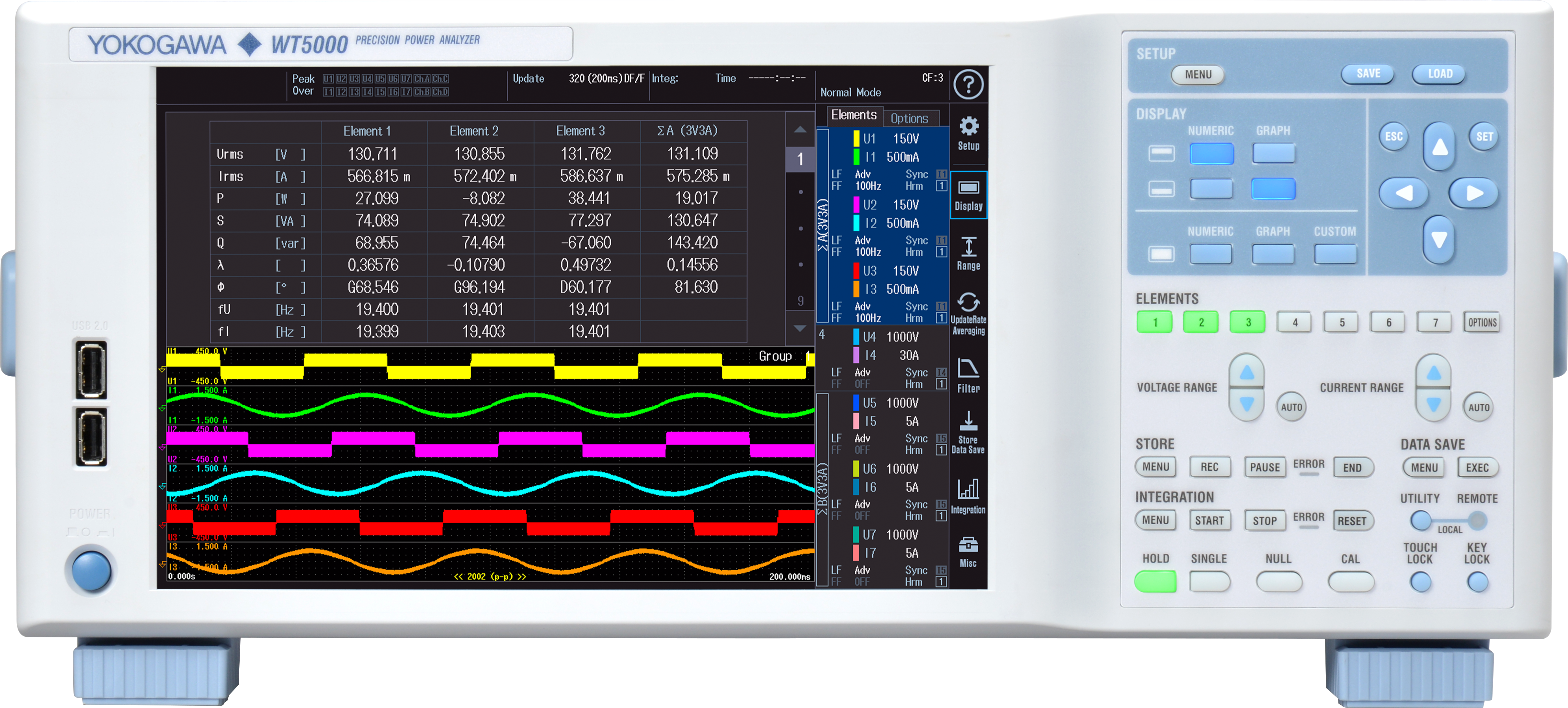
Yokogawa Model WT5000 Power Analyzer

The power analyzer provides complete power measurement on the avionic component, as required by DO-160E: voltage, current, real power (W), apparent power (VA), reactive power (var), power factor, and efficiency over the operating frequency of the aircraft power system. AC power and harmonic analysis run in a single instrument, and the analyzer is designed for high-accuracy current measurements that other harmonic analysis instruments cannot easily match.
For high-current applications, Yokogawa also provides precision high-frequency current transformers with wide-band response out to 150 kHz.
Yokogawa WT1500 Precision Power Analyzer for automated testing

Designed for automated test systems, the WT1500 combines four power channels and four motor channels in a compact 2U rack-mount chassis (benchtop version also available). For DO-160 qualification and production test lines it offers:
- ±0.038% total power accuracy (DC, 50/60 Hz) and 2 MHz bandwidth
- Direct measurement up to 2000 V
- Automation interfaces: CAN/CAN FD, UDP, IEEE 1588 time synchronization, and a built-in web server
- Up to five units synchronized for 20 power channels
- Fast 10 ms updates with automatic frequency tracking
Yokogawa DL950 ScopeCorder with 720301 power module
For test setups that also need waveform capture, the DL950 ScopeCorder with the 720301 power module and the /G05 power math option adds power measurement with specified accuracy to a high-speed waveform recorder. Each module has one isolated voltage input (up to 1000 Vrms) and one current sensor input, with 16-bit resolution, 1 MS/s sampling, and DC to 300 kHz bandwidth.
- Guaranteed power accuracy of ±0.14% (DC, 50/60 Hz), excluding current sensor accuracy
- Cycle-by-cycle power calculation at intervals as short as 0.1 ms, with two power systems (single- or three-phase)
- Power values synchronized with voltage and current waveforms, CAN FD, vibration, temperature, and other signals in one instrument, which suits transient and abnormal-power event capture
The DL950 harmonic analysis covers up to 40 orders on fundamentals up to 1 kHz, and its power accuracy is specified at DC and 50/60 Hz, so the DL950 complements, rather than replaces, a power analyzer for DO-160 Section 16. The WT5000 remains the recommended instrument for harmonic analysis out to 500 orders and for 400 Hz and variable-frequency accuracy.
Harmonic measurements
Harmonic magnitude values for both voltage and current must be measured and the Total Harmonic Distortion (THD) calculated, along with the individual harmonic content (Harmonic Distortion Factor, %hdf) expressed as a percentage of the fundamental. Yokogawa power analyzers present a numeric display of each harmonic order with magnitude and %hdf.

Sample numeric display of harmonic voltage magnitudes and individual harmonic content (%hdf) for each harmonic order out to 500 orders.
DO-160E requirements vs. Yokogawa solutions
The table below outlines the DO-160E requirements and the solution provided by each Yokogawa power analyzer.
| Parameter | Guideline | WT5000 | WT1800R | WT1500 | DL950 + 720301 |
|---|---|---|---|---|---|
| Accuracy | 5% | 0.03% @ 400 Hz | 0.3% @ 400 Hz | Voltage/current: 0.03% rdg + 0.05% rng; power: 0.05% rdg + 0.05% rng @ 400 Hz | 0.14% @ 50/60 Hz; specified at DC and 50/60 Hz only |
| Sample rate | 100 kHz or greater | 10 MS/sec | 2 MS/sec | 2.5 MS/sec | 1 MS/sec |
| Time window | 0.05 sec or longer | 0.05 sec or longer | 0.05 sec or longer | Selectable data update interval, 50 ms or longer | Edge-synchronized; update interval 0.1 ms to 500 ms |
| Filter | 25–50 kHz | 5.5 or 50 kHz | 5.5 kHz | Line filter 100 Hz to 200 kHz or 300 kHz; analog anti-aliasing filter | Line filter: 40 kHz / 4 kHz / 400 Hz / full band |
| Window | Rectangular, Hanning, Hamming, Blackman-Harris |
Rectangular | Rectangular | Rectangular | Not specified |
| Harmonic content | Current magnitude for 400 Hz multiple frequencies up to 150 kHz | THD & harmonic analysis, 50 orders up to 1 kHz fundamental FFT function up to 100 kHz |
THD & harmonic analysis, 50 orders up to 1 kHz fundamental | THD & harmonic analysis, up to 100 orders, fundamental 0.1 Hz to 2.6 kHz | THD & harmonic analysis, up to 40 orders (voltage, current) and 35 orders (active power); fundamental up to 1 kHz; 4096-point FFT |
| Boeing 787 power quality harmonic content | THD & harmonic analysis of current and voltage magnitude up to 62 orders at 800 Hz fundamental |
THD & harmonic analysis up to 500 orders, up to 800 Hz fundamental | THD & harmonic analysis, 50 orders up to 1 kHz fundamental | THD & harmonic analysis up to 100 orders at 800 Hz fundamental; 500 orders not supported | Not supported (40 orders maximum) |
Conclusion
Choose the proper test instrumentation to make accurate current, voltage, and power measurements and AC harmonic distortion analysis on aircraft electrical systems and equipment, as defined by DO-160E, Airbus ABD0100.1.8, and the Boeing B787 Power Quality specifications.
Yokogawa precision power analyzers (WT5000, WT1800R, and WT1500), together with the DL950 ScopeCorder for combined waveform and power capture, offer a measurement solution that meets or exceeds industry test requirements and provides the following benefits:
- Ease of use: measurements made quickly, conveniently, and accurately
- DC and AC current, voltage, power, and harmonic measurements in one instrument
- Harmonic analysis up to 500 orders on an 800 Hz fundamental to meet the latest Boeing requirements
- Automation-ready integration for test racks and production lines (WT1500)
- 3-year warranty on power analyzers
- Full NIST and ISO 17025 traceable calibration services
Related Industries
Related Products & Solutions

Power Analyzers and Power Meters
Industry-leading accuracy for efficiency, harmonics, and power parameters, ensuring regulatory compliance and confident design of energy-efficient systems.

Power Measurement (Wattmeter) Module
- 2-Channel (1 Voltage and 1 Current Sensor)
- 1 MS/sec, 16-Bit
- 300 kHz Bandwidth
- Max. Input Voltage (DC + ACpeak): 1000V (Voltage) / 10V (Current)
- Accuracy Guaranteed Range: DC, 0.1 Hz to 100 kHz
*To perform calculations for RMS values or power values with guaranteed accuracy, the /G05 or /MT1 option is required.

WT1500 - For Automated Test Systems
- Up to 4 wattmeters
- 0.018% of rdg + 0.02% of rng
- DC, 0.1Hz to 1MHz
- 4 motor inputs
- Harmonics to 100th order

WT1800R High-Performance
- Up to 6 wattmeters
- 0.05% of rdg + 0.05% of rng
- DC, 0.1Hz to 1MHz
- 2 motor inputs
- Harmonics to 500th order

WT5000 - Highest Precision
- Up to 7 wattmeters / Modular
- 0.01% of rdg + 0.02% of rng
- DC to 1MHz
- 4 motor inputs
- Harmonics to 500th order
- IEC 61000 compliance testing