Generating Voltage and Current Harmonics for Power Quality Testing with AC Power Calibrators

Figure 1. Fundamentals and harmonics in the voltage and current of an AC power supply
1. Introduction
1.1 Harmonics
In an ideal world, AC power sources generate perfect sine waves, but real-world voltage and current waveforms inevitably exhibit distortion. A pure sine wave consists solely of a fundamental frequency (e.g. 50/60 Hz), whereas a distorted waveform also includes harmonic components— integer multiples of the fundamental frequency. These harmonics can compromise power quality, leading to adverse effects such as overheating, malfunction, reduced efficiency and lifespan. For this reason, various laws, regulations, and guidelines define acceptable levels harmonics emitted by equipment and devices.
The growing use of power electronics in consumer and industrial applications—such as energy-efficient inverters in air conditioners—heightens the risk of power quality deterioration, making it even more important to control and suppress harmonics.
1.2 Harmonic Generation for Calibration and Testing
• Device Development and Final Evaluation
In the last stages of developing power-related devices—such as inverters—it is necessary to measure each harmonic component and the total harmonic distortion (THD). A power analyzer with harmonic measurement capabilities is typically used to ensure the device meets performance and regulatory requirements.
• Testing and Calibrating Power Analyzers
When evaluating a power analyzer’s ability to measure harmonics accurately, a controlled voltage or current signal with precisely defined harmonic content must be generated.
This allows for verifying the analyzer’s performance against a traceable reference. The same principle applies to power quality analyzers (PQAs), which also require calibration signals with known harmonic levels.
• Protective Relays and Other Power Equipment
Protective relays and similar power equipment must be designed to handle disturbances caused by harmonics.
Consequently, generating voltage and current waveforms that contain specific harmonic components helps to verify operating tolerances under realistic operating conditions.
2. Challenges
High-end power calibrators and specialized test devices can generate voltage and current harmonics, but they often require expert operation, have large form factors, and entail high initial and maintenance costs—including regular calibration. Meanwhile, a simple DC or AC power supply might suffice for fundamental frequency (e.g. 50/60 Hz) testing, but cannot provide a traceable reference that includes harmonic content. Consequently, there is a clear need for a more practical, cost-effective solution that can generate traceable AC voltage and current waveforms with harmonic content.
3. Solutions Provided by the LS3300
The Yokogawa LS3300 AC power calibrator addresses these challenges by allowing accurate harmonic generation with simple operation.
With the harmonic output option, the LS3300 enables output with superimposed harmonic component using a single unit.
This eliminates the need to prepare two units—one for the fundamental wave and another for harmonics—and to perform external wiring connections, allowing stable harmonic output with a simplified configuration.
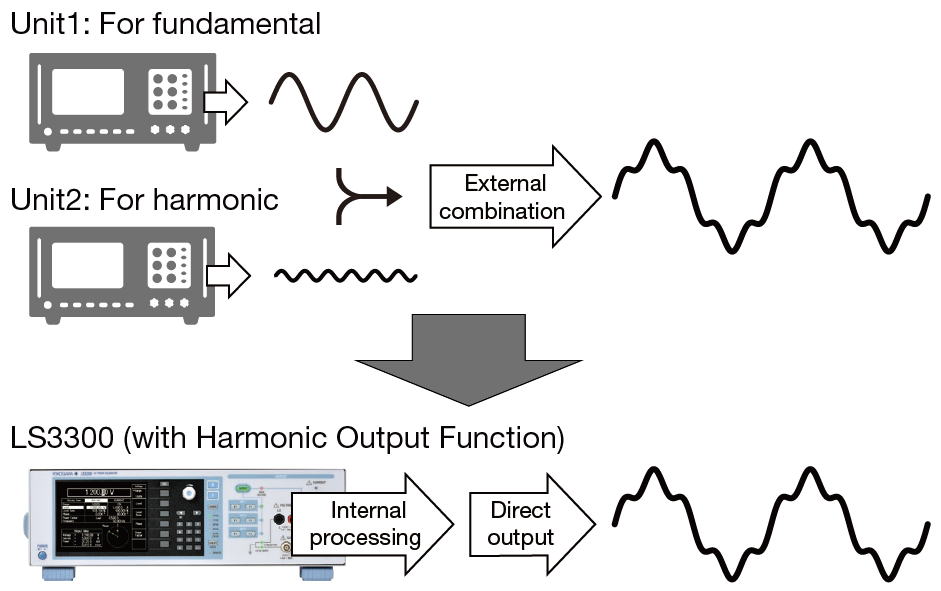
Figure 2. LS3300 replacing multi-unit setup for harmonic superimposition
With the harmonic output function (/HRM1 option), any single harmonic up to the 51st order can be selected and superimposed within a range of up to 20% of the fundamental component. This allows stable output of a signal that accurately includes the specified harmonic component, serving as a reference for calibration.
In addition, a custom-order model* is available that allows remote control from a PC using dedicated communication commands, enabling the generation of voltage and current with multiple harmonics superimposed.
* For details on the special-order model including its price and specifications,please contact our sales representatives.
LS3300

Figure 3. LS3300 AC Power Calibrator
• High Accuracy and Stability
Leveraging Yokogawa’s experience in power analyzer and power source products, the LS3300 offers exceptional accuracy and stability in a compact, portable design. It has sufficient accuracy to calibrate 0.15% accuracy class power meters without the need for an additional reference meter.
• Easy Operation and Automation
The intuitive interface and intelligent linking features allow for quick setup and operation, including single-phase through three-phase calibration. Dedicated power meter calibration software further streamlines the process, enabling automatic calibration of power meters*4 and helping achieve high-quality results in minimal time.*5
With its blend of precision, traceability, user-friendly design, and affordability, the LS3300 is a practical solution for anyone needing to generate precise harmonic waveforms for device testing, power analyzer calibration, and power equipment evaluation.
*4 Yokogawa WT300E, WT300, WT200 series, WT100 series
*5 For DC calibration, use the 2560A DC Calibrator with the LS3300.

Figure 4. Power Meter Calibration Software
Related Industries
Related Products & Solutions

LS3300 AC Power Calibrator
- V/I/P Accuracy: ±350/450/450 ppm
- Frequency: 40 to 1200 Hz
- Max. Output: ~36 VA

