Evolution of AI Data Center Networking Infrastructure
The rapid growth of generative AI and large language models is accelerating demand for large-scale AI data centers. As AI clusters scale, high-speed, high-capacity optical connectivity within and between data centers is becoming critical to performance, power efficiency, and scalability.
To meet these demands, advanced optical communication architectures - including silicon photonics, optical engines, and co-packaged optics - are being developed and deployed, making accurate optical measurement and validation increasingly important.
AI Optical Communications Challenges
As AI optical communication systems shift toward higher performance, higher density, and greater integration, validation is becoming more difficult. With increasing laser output power and tighter optical performance requirements, small variations in spectrum shape, wavelength, optical power, loss, reflection, or coupling efficiency can affect communication quality, production yield, and long-term reliability. This makes precise, repeatable, and scalable optical measurement increasingly important as devices become more complex, tolerances become tighter, and production volumes continue to grow.
Common challenges include:
- Detecting side modes and spectral changes as laser output power increases
- Ensuring wavelength accuracy and channel stability in WDM systems
- Finding loss, reflection, and coupling issues inside complex PICs and waveguides
- Evaluating optical fiber loss, reflection, and fault locations with confidence
- Reducing test time as production test items and channel counts increase
- Identifying root causes of failures and ensuring consistent quality from R&D to production
Optical Architecture of Future Data Center
As bandwidth and network complexity increase, architectures are evolving from pluggable transceivers toward co-packaged optics, optical I/O, and increasingly optical switching. By shortening high-speed electrical paths and reducing dependence on copper interconnects, these technologies can lower power consumption and heat while enabling higher bandwidth and greater network scalability.
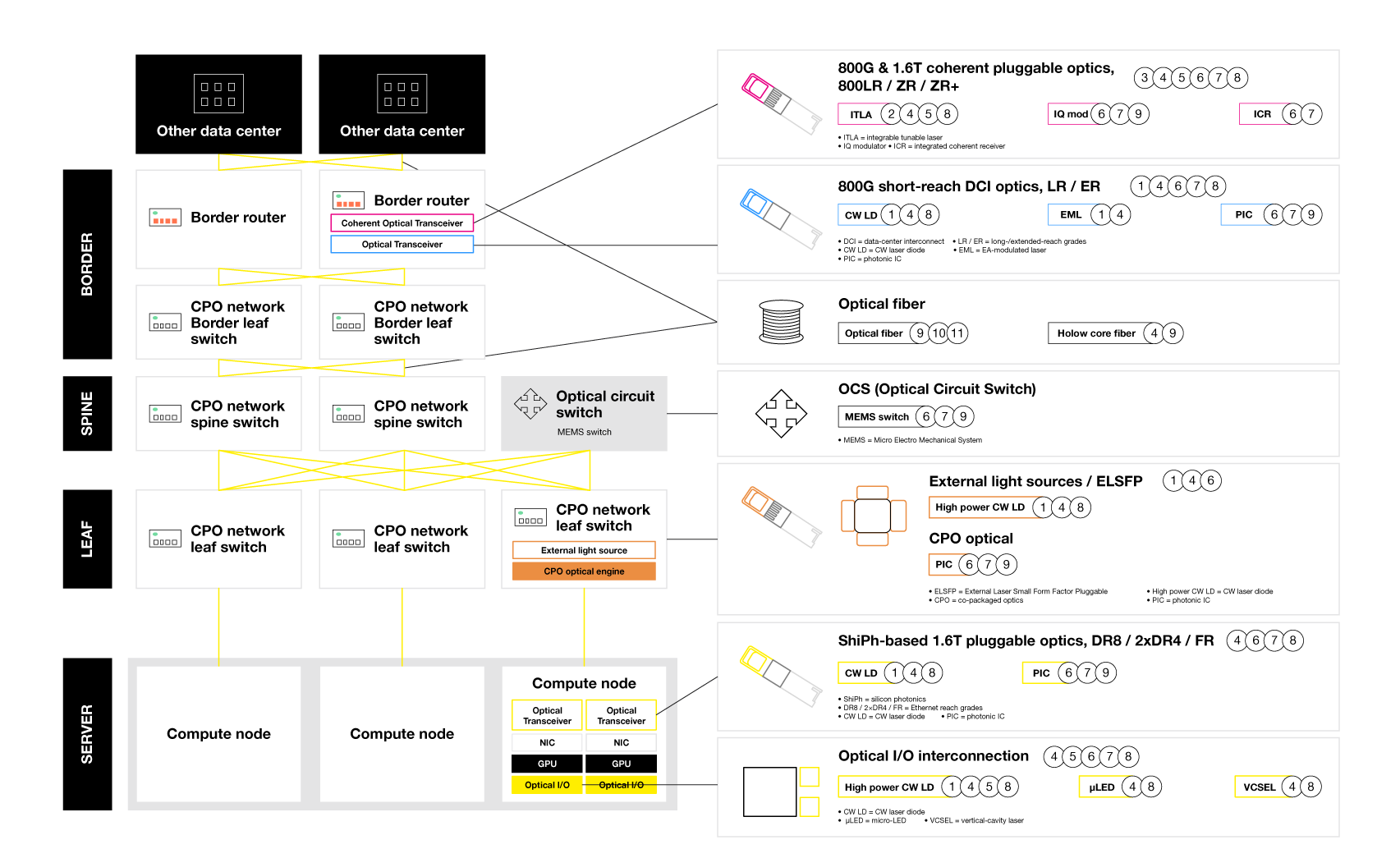
Optics Are Moving Deeper into the Data Center
Yokogawa offers a broad portfolio of optical test solutions to support the development, production, and deployment of AI networking infrastructure. Optical spectrum analyzers, wavelength meters, OTDRs, high-resolution reflectometers, and optical component test systems help engineers characterize lasers, validate WDM signals, evaluate PICs and optical fibers, identify failures, and improve production test efficiency. For each instrument, example measurements are listed and referenced in the architecture diagram above.


Optical transceivers are one of the indispensable key devices for optical communications that interconvert optical and electrical signals.

To accurately measure pulsed light using an optical spectrum analyzer (OSA), it is necessary to understand the characteristics of the OSA and select the appropriate measurement method and settings.


(Enlightra)

Product Overviews

Suchen Sie mehr Informationen über unsere Mitarbeiter, Technologie oder Lösungen?
Ihr Kontakt zu uns

