Electric Vehicle Powertrain Testing Solutions
Gain valuable insight into the performance of electric powertrain systems without second-guessing the quality of your power measurements. From the battery to the motor output and everything in between, Yokogawa's wide range of instruments enable engineers to confidently and comprehensively analyze electromechanical challenges of EV powertrain systems.

Understanding and Quantifying Power Loss in EV Powertrains
To develop and optimize efficient and sustainable transportation solutions, it’s critical that engineers and researchers accurately identify, quantify, and understand the losses from each component (e.g., battery, inverter, motor) as power flows through the complex network of an electric vehicle powertrain system.
Effective measurement and analysis of the various measurement test points along an EV powertrain requires specialized equipment such as power analyzers to ensure the highest quality data with the fewest potential trade-offs. Selecting the instrument best suited to a specific application ultimately comes down to the application's required level of accuracy, number of channels needed, and types of signals being acquired.
For automated inverter and motor testing, the WT1500 Precision Power Analyzer measures up to 2,000 V DC directly with ±0.038% power accuracy, up to four wattmeters, and a compact 2U design built for test racks.
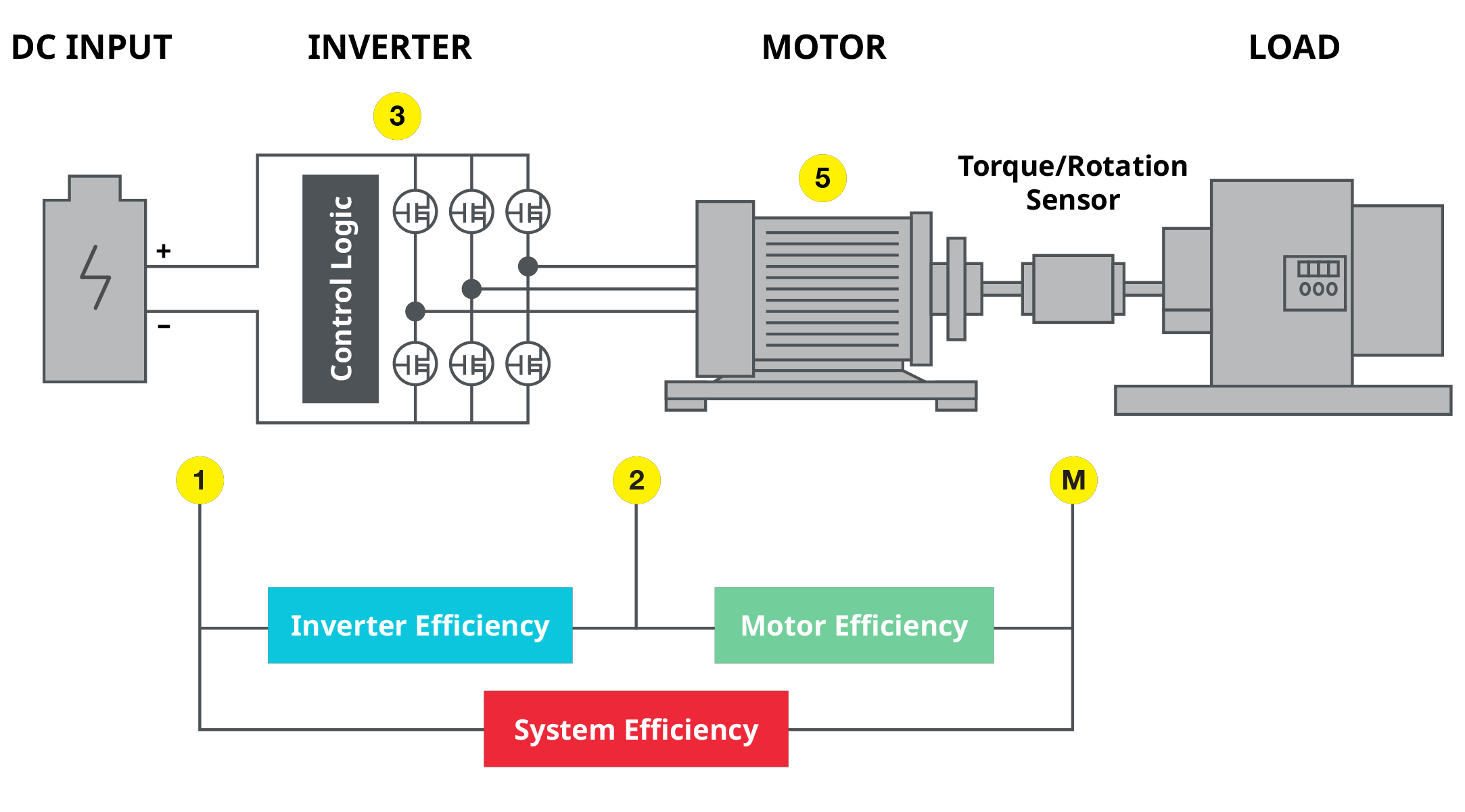
Revolutionizing EV Powertrain Testing with Integrated Measurement Tools
Yokogawa’s suite of high-precision instruments, including the ScopeCorder, Power Analyzer, Oscilloscope, and Data Acquisition devices, work together seamlessly to deliver world-class electric vehicle powertrain testing results. Leveraging our advanced integrated software platform, our tools collectively ensure precise measurement, analysis, and optimization of every component within the EV powertrain system.
- ScopeCorder: Captures waveforms, flow, vibration, resolver signals, and CAN bus data, providing a detailed overview of dynamic and static signals in real time.
- Power Analyzer: Measures AC/DC voltage and current, power, encoder signals, torque, and efficiency to evaluate energy transfer and loss within the powertrain.
- Oscilloscope: Monitors CAN bus, SPI bus, I2C bus, isolated voltage, IGBT signals, and flow, essential for detailed analysis of electronic control units and other complex circuits.
- Data Acquisition Devices: Collect temperature, DC voltage, frequency, and input/output data to ensure comprehensive environmental and electrical condition monitoring.


Electric Motor & Variable Speed Drive Testing
White Paper
Understanding power generation, power loss, and the different types of power measured can be intimidating. This white paper gives an overview of basic electric and mechanical power measurements and the interfacing of drives in motors.
Read the White Paper

eBook

Electrical Motor Power Measurement & Analysis
A guide of common measurements and parameters to drive greater efficiency.
Download eBook
Webinar

Motor & Drive Control System Measurements
Learn how to more effectively benchmark data for and troubleshoot issues with energy efficiency in EV powertrains.
View Webinar
Case Study

Solar Team Twente
Accurate power analysis boosts solar race car's range and speed.
Download Case Study


Use built-in calculations to analyze motor rotor position of Brushless DC motors (BLDC) and Permanent Magnet Synchronous Machines (PMSM) and find the relative angle between the rotor and position sensors such as encoders or resolvers

Maximum torque per ampere (MTPA) is an optimization strategy for the control of electric motors and drives that employ field-oriented control (FOC), particularly with electric vehicles (EVs) and industrial automation applications. The goal of MTPA is to achieve the maximum possible torque output from a motor for a given current input.

How can I capture data from motion sensors synchronized with other analog data? The Yokogawa ScopeCorder series of instruments feature input modules and functions to make this possible.

Large Capacity/Motor Characterization for Hybrid Car Development

Standards driving energy efficiency classifications are a driving force behind the development of the next generation of motor and drive technologies. Learn more here.

As a respected pioneer in folding bikes, Brompton’s first foldable e-bikes was eagerly anticipated. However, to develop such high-performance e-bikes engineers at Brompton needed to perform comprehensive dynamic testing to achieve rider – bike harmony.

As a one of the largest motorcycle manufacturers, Triumph confirms every bike is precision-engineered to deliver a complete riding experience. To ensure higher performance and efficiency of the motorcycle powertrain, Triumph test their engines under rigorous conditions, measuring and analyzing a vast array of parameters under varying conditions, from sensors configured and positioned all around a bike.


Product Overviews

Webinars
- Establishing baselines for system efficiency
- Conducting inverter control signal analysis at the systems level
- Identifying critical measurements for benchmarking inverter input, inverter output, and motor output
- Analyzing motor control signals, including torque control variables, positional sensors, and pulse-width modulation (PWM), as well as torque measurements

With ongoing innovations in motor and inverter technologies seeking to advance global decarbonization objectives in the automotive industry, it’s crucial that engineers have a thorough understanding of how to properly analyze these systems.
This complimentary webinar provides engineering professionals involved in motor and control system development with insights that enable data benchmarking and troubleshooting issues related to energy efficiency in electric vehicle (EV) powertrains.
Key webinar topics include:

Zwei neue isolierte Eingangsmodule für die modulare ScopeCorder-Serie vor. Die neuen Module unterstützen die Validierung bei Anwendungen in den Bereichen Energiespeichersysteme, Leistungselektronik und hochdynamische Stromversorgungen.
Erweiterung des bewährten LS3300 AC-Leistungskalibrators: Ab sofort kann das Gerät auch optional eine Oberschwingung – also ein Vielfaches der Grundschwingungsfrequenz – erzeugen und der Grundschwingung überlagern.
Der WT1800R übernimmt die Hoch- und Niederstrom-Eingangselemente und die Stromversorgung für externe Nullfluss-Stromwandler bis 2000 A der Vorgängerserie WT1800E und bietet jetzt u. a. eine erweiterte Anzahl von mathematischen Funktionen ...
Learn how VDE’s innovative approach, combined with our WT3000E power meter technology, is shaping the future of EV infrastructure and energy metering at public charging points. This powerful collaboration ensures consumer trust and confidence in electric vehicle charging.
Eines der wirksamsten Instrumente im Kampf gegen Luftverschmutzung und Kohlenstoffemissionen ist die Gasabsorptionsspektroskopie MicroPhotons stellt sich dieser Herausforderung, indem es unterkühlte Laserquellen durch eine Superkontinuum-Lichtquelle für Gasabsorptionsmessungen bei Raumtemperatur ersetzt. Lesen Sie mehr...
Suchen Sie mehr Informationen über unsere Mitarbeiter, Technologie oder Lösungen?
Ihr Kontakt zu uns

