Maximize Power Conversion
Efficiency improvements in the development and compliance cycles mean a faster route to production and sales. Yokogawa Test&Measurement has the tools that enable test engineers to more effectively analyze electric charging systems, from board to system level. Whether you are benchmarking efficiency, troubleshooting power electronics, or ensuring compliance, explore our specialized suite of solutions for EV charging systems.
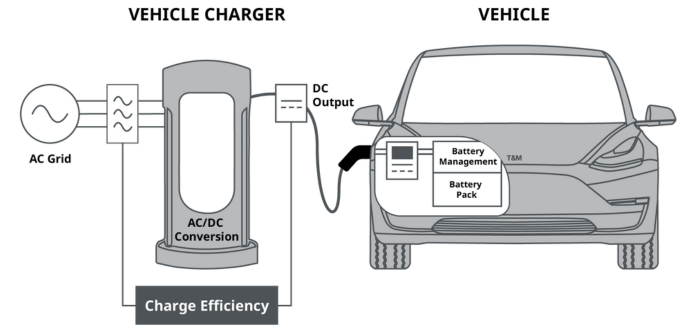

Charging systems require specialized instrumentation purpose-built to perform key measurements at a system’s input and outputs. Selecting the best instrument for each application depends on the level of accuracy required, the number of channels needed, and the type of signal being acquired.
For high-voltage DC fast-charger testing in automated test systems, the WT1500 Precision Power Analyzer measures up to 2,000 V directly, without external voltage dividers, in a compact 2U design.

Choosing the Right Instrument for Power Quality and Energy Efficiency - Power Compliance, Efficiency, and Harmonics Tests
Application Note
Three variables to consider are measurement type, measurement standard, and instrument type. This guide defines these variables and provides helps to select the best instrument for your application.
Read the App Note

Power Quality and Energy Efficiency for Power Measurements
White Paper
More than 40% of the total energy consumed in the United States is used to operate buildings. This white paper explains the relationship between power efficiency and power quality and identifies causes and types of power quality issues.
Read the White Paper

eBook
Electricity Applied
A handbook of common applications and key measurement parameters.
Click to learn more
Webinar
Mastering Harmonics
Ensure Power System Efficiency and Standards Compliance
Click to learn more
Case Study
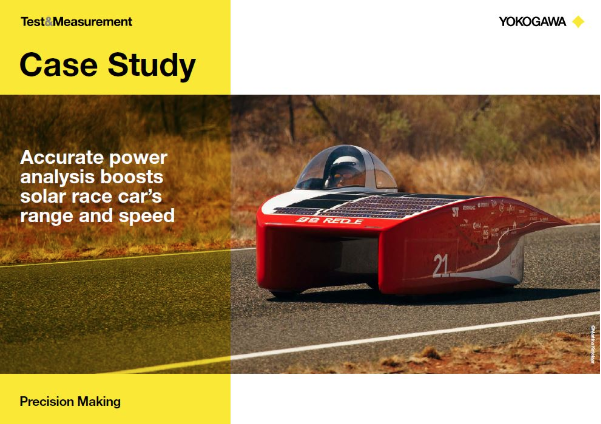
Solar Team Twente
Accurate power analysis boosts solar race car's range and speed
Click to learn more

【search key】 WT5, WT50, WT500, WT


Evaluating Electrical Vehicles Non-Contact Charging Systems

Editorial
Globale Expertise
& lokale Präsenz – Seite 3
Reportage
SAXOGY: Leistungselektronik sicher prüfen.
Sicherheitsprüfstand für Umrichter – Seite 4
Neuheiten
Rechenzentren: Validierung von
Energiespeichern und USV-Systemen.
Neue Eingangsmodule erweitern die
ScopeCorder-Familie – Seite 9
Hintergrund
SmartDAC+ Easy Predictive Detection
für Wärmebehandlungsanlagen.
KI-basierte fortlaufende Überwachung des
Anlagenzustands – Seite 10

As a respected pioneer in folding bikes, Brompton’s first foldable e-bikes was eagerly anticipated. However, to develop such high-performance e-bikes engineers at Brompton needed to perform comprehensive dynamic testing to achieve rider – bike harmony.

As a one of the largest motorcycle manufacturers, Triumph confirms every bike is precision-engineered to deliver a complete riding experience. To ensure higher performance and efficiency of the motorcycle powertrain, Triumph test their engines under rigorous conditions, measuring and analyzing a vast array of parameters under varying conditions, from sensors configured and positioned all around a bike.


How-tos

This video demonstrates how to measure transient phenomena on power signals using the Yokogawa Test&Measurement PX8000 Precision Power Scope.
In several applications, especially those testing AC power to a standard such as IEC61000-3-11, the voltage and current signals must be monitored to confirm there are no major dips and/or swells in the signal. This can be done with instruments capable of reporting rms values, including power analyzers, traditional oscilloscopes, and some data acquisition systems.
To test to a standard, however, the instrument must have an accuracy spec that is traceable back to a national standard of calibration such as ISO17025 or NIST.
Webinars
- Multi-phase measurements
- Measurement techniques
- Measurement applications
- Real-world examples and more


While DC power measurements are relatively straight forward, AC power measurements that include distorted waveforms, varying power factors, and multiple phases can add complexity to an otherwise simple measurement. During this webinar, we cover multiple fundamentals of power measurement.
Key topics include:
Zwei neue isolierte Eingangsmodule für die modulare ScopeCorder-Serie vor. Die neuen Module unterstützen die Validierung bei Anwendungen in den Bereichen Energiespeichersysteme, Leistungselektronik und hochdynamische Stromversorgungen.
Erweiterung des bewährten LS3300 AC-Leistungskalibrators: Ab sofort kann das Gerät auch optional eine Oberschwingung – also ein Vielfaches der Grundschwingungsfrequenz – erzeugen und der Grundschwingung überlagern.
Der WT1800R übernimmt die Hoch- und Niederstrom-Eingangselemente und die Stromversorgung für externe Nullfluss-Stromwandler bis 2000 A der Vorgängerserie WT1800E und bietet jetzt u. a. eine erweiterte Anzahl von mathematischen Funktionen ...
Suchen Sie mehr Informationen über unsere Mitarbeiter, Technologie oder Lösungen?
Ihr Kontakt zu uns

